What is human resource planning (HRP)? Human resource planning (HRP) is the process of systematically forecasting an organization’s future workforce needs and building strategies to meet them. It aligns talent strategy with business goals to drive performance and reduce costly workforce gaps.
Successful business strategies depend on having the right people in the right roles at the right time. But that doesn’t happen without a clear plan for how the organization will hire, develop, and retain talent as business needs change.
Human resource planning gives HR leaders a practical way to make those decisions with more confidence. That matters even more when the data behind those decisions is incomplete or inconsistent. HiBob’s 2026 global manager survey, based on 4,700 people managers across six regions, found that 68 percent say missing or conflicting information leads to worse business outcomes at least half the time.
HRP helps reduce that risk by giving teams a more structured approach to forecasting workforce needs, identifying skill gaps, and planning ahead before those gaps affect performance. In this article, we look at what HRP means, why it matters, and how to build an effective process. You’ll find a step-by-step walkthrough, a breakdown of the main planning types, and an overview of the tools that support better workforce decisions.
<< Ensure your HR processes are up to standard with our HR audit checklist. >>
Key insights
- Human resource planning (HRP) is the process of identifying an organization’s current and future workforce needs and creating plans to ensure the right people, skills, and resources are in place to achieve business goals
- Effective HRP supports sustainability by proactively planning for growth, skill development, and role evolution, ultimately boosting adaptability to industry shifts
- Essential steps involve assessing the current workforce, forecasting needs, identifying gaps, creating a strategic plan, and regular reviews
- Key challenges include managing unpredictable workforce changes, data integration, and resistance to change
- HR technology aids HRP by streamlining data analysis and long-term workforce planning
What is human resource planning (HRP)?
Human resource planning is a systematic, ongoing process that helps organizations understand the workforce they need today and prepare for what comes next.
As hybrid and flexible work expand access to talent across locations, HRP helps HR teams plan more effectively for distributed teams. It gives leaders the visibility to understand where talent is needed, which skills matter most, and how to align people across functions and geographies.
The goal is to create a workforce that can meet today’s priorities and tomorrow’s ambitions by connecting hiring, development, retention, and workforce optimization into one strategic plan.
HRP vs workforce planning
Workforce planning and HR planning are closely connected, but they serve different purposes. Here’s how they differ in time horizon, scope, and output:
| Category | Workforce planning | Human resource planning (HRP) |
| Time horizon | Short-term (0-12 months) | Medium-term (1-3 years) |
| Primary focus | Filling current roles and managing immediate headcount needs | Forecasting workforce needs and building plans for hiring, development, and retention |
| Scope | Operational: Scheduling, headcount, near-term hiring | Broader people planning: Hiring, skills, development, retention, and workforce optimization |
| Key activities | Headcount tracking, backfills, hiring approvals | Skills gap analysis, talent pipeline building, development planning, retention strategies |
| Who leads it | Line managers and HR operations | HR leaders and HR business partners |
| Key output | Staffing plans and near-term hiring targets | Workforce plans that support business goals over time |
Why is human resource planning important?
Workforce gaps don’t announce themselves in advance. Organizations best equipped to handle growth, market shifts, or unexpected disruption are those that plan deliberately for their people needs—not just financial ones.
HRP creates that structure. It gives HR leaders a clear view of current capabilities and future requirements, so decisions are proactive rather than reactive.
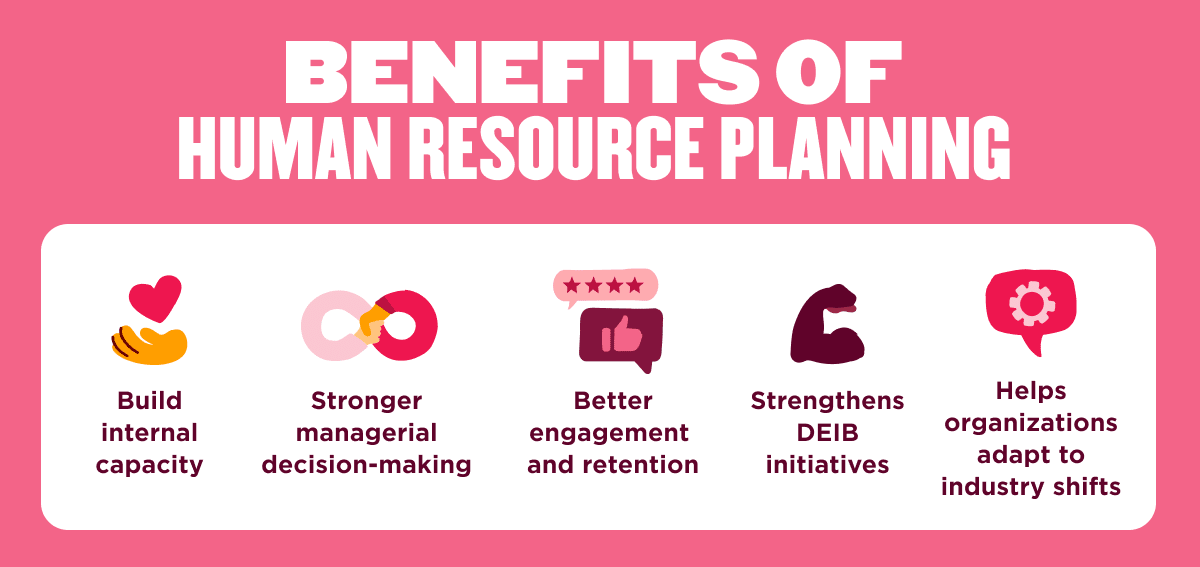
- Builds internal capacity. HRP helps organizations use existing skills more strategically and reduce overreliance on external hiring. SHRM’s benchmarking data puts the average cost-per-hire at $4,700, a figure that rises sharply for senior roles.
- Stronger managerial decision-making. HRP gives managers a clearer picture of workforce capabilities, capacity, and skills, so people decisions are grounded in data rather than intuition. That visibility matters: HiBob’s report found that between 74 and 76 percent of managers had at least some people decisions formally challenged or appealed in the past year. Better workforce data helps managers make decisions they can explain, support, and apply more consistently.
- Better engagement and retention. When HRP connects development paths to business goals, team members can see where they fit today and how they can grow. That clarity strengthens engagement, supports internal mobility, and helps organizations retain top talent. LinkedIn’s Workplace Learning Report found that 94 percent of people say they’d stay at a company longer if it invested in their development.
- Helps organizations adapt to industry shifts: Through HRP, organizations can anticipate changes in talent needs and industry dynamics, managing role transitions and budgeting for new positions before gaps become urgent. That kind of planning is increasingly critical: Gartner’s 2026 HR Trends found that 64 percent of HR leaders believe their organization lacks the talent pipeline needed to execute its business strategy over the next three years. HRP helps close that gap by connecting future business priorities to workforce planning today.
- Strengthens DEI&B initiatives: Deliberate workforce planning creates space to embed diversity, equity, inclusion, and belonging into hiring, development, and succession decisions, making them part of the strategy rather than an afterthought. McKinsey’s Diversity Wins report found that companies in the top quartile for gender diversity on executive teams are 25 percent more likely to achieve above-average profitability, rising to 36 percent for ethnic diversity. While diversity alone doesn’t guarantee performance, inclusive workforce planning belongs in a broader business strategy.
Essential steps in human resource planning
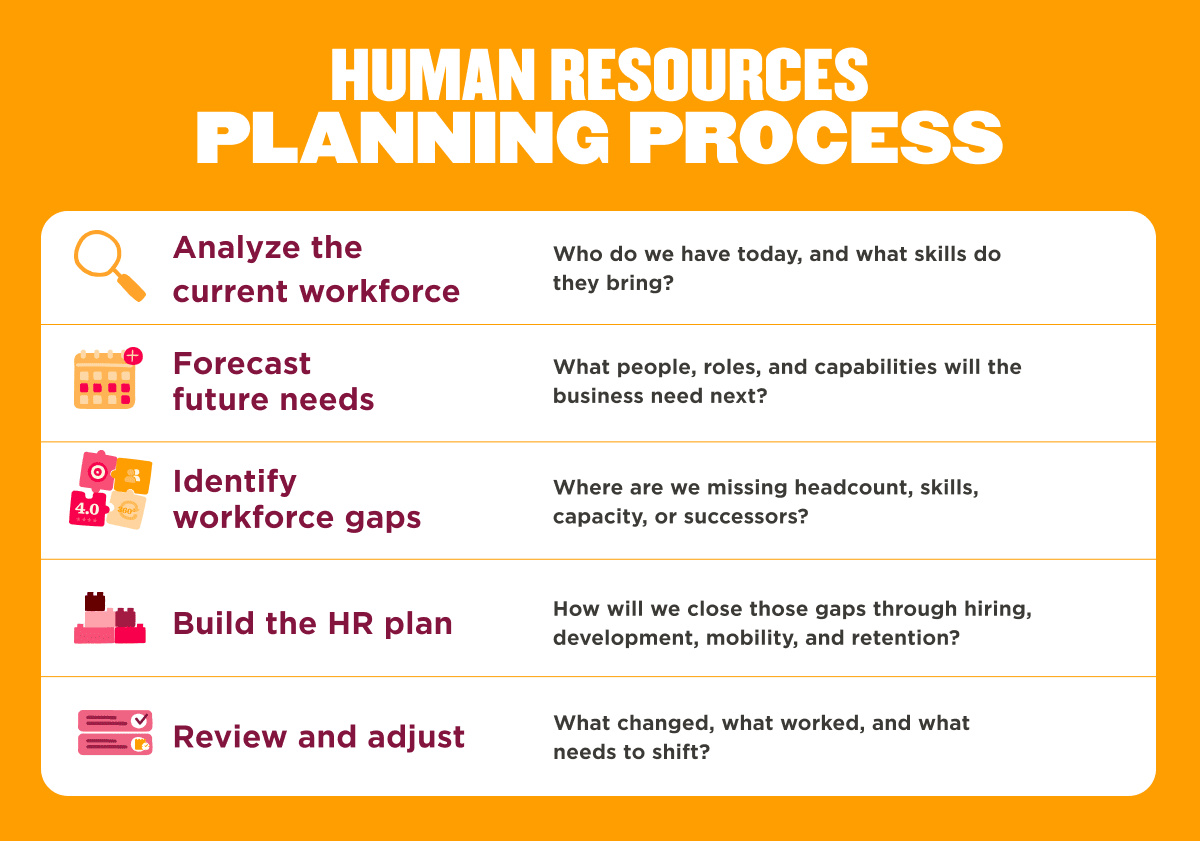
HRP is a structured process that usually includes:
1. Analyzing the current workforce
Before planning for the future, take stock of the present. A thorough workforce analysis looks at the total number of people across the organization, their departments, job titles, skills, tenure, and performance data. This baseline reveals what capabilities exist today, where strengths lie, and where vulnerabilities are beginning to surface.
2. Forecasting changes
With a clear baseline in place, the next step is forecasting future workforce needs. This is where supply and demand dynamics come into play and where the analysis gets more nuanced. Teams can use various types of forecasting:
- Demand forecasting identifies the types and volume of talent the organization will need to meet future business goals. It factors in growth plans, market expansion, new products or services, and expected shifts in how work gets done.
- Talent supply forecasting assesses whether the current workforce and the available external talent market can meet that demand. It accounts for planned attrition, retirement timelines, internal mobility potential, and the competitive landscape for key roles.
- Scenario planning stress-tests workforce forecasts against different possible futures. What happens if a key market contracts? What changes if a critical role becomes harder to fill? How would automation reshape a core function? Planning for multiple outcomes helps HR teams build more resilience into HRP and adjust before changing conditions create urgent talent gaps. McKinsey found that applying a consistent and transparent scenario planning process across different business units and teams increases workforce flexibility by about 20 percent.
3. Carrying out gap analysis
After forecasting, the next step is gap analysis. This involves comparing your current workforce quantity and skill levels against what’s necessary to meet your organizational goals—recognizing current status, defining your ideal future state, and spotting the gaps that need filling.
Start by mapping three areas:
- Current workforce: Headcount by role, critical skills people have, and planned absences, exits, or transitions
- Future workforce: The headcount, skills, and capabilities the organization needs based on business goals and demand forecasts
- Workforce gaps: Headcount shortfalls or surpluses, skills at risk from attrition, capabilities to build, and leadership pipeline risks
Then turn those gaps into action. Headcount shortages may require targeted recruitment with realistic timelines. Surpluses may call for internal moves, natural attrition planning, or a closer look at whether the gap is temporary. Skill gaps can inform upskilling and reskilling plans, while pipeline gaps can guide succession planning before critical roles become urgent.
Recommended For Further Reading
- The profitability of people-centric HR programs
- The key to a recession-proof business: spotting and growing leaders from within
- The Big Stay: The secret to boosting your engagement and retention
- HR process improvement guide
- 10 best HRIS for ease of use and simplicity in 2026
- 10 best HR software platforms for UK companies in 2026
4. Developing your HR plan
With a clear view of your workforce needs, gaps, and priorities, you can build an HR plan that supports the broader business strategy. Focus on the actions that will help close talent gaps, strengthen retention, and prepare the organization for future needs.
Your plan should include:
- A workforce gap summary prioritized by business impact
- Recruitment priorities for net-new, critical, or hard-to-fill roles, with targets by function, level, and timeline
- Learning and development plans tied to specific skill gaps, including reskilling and upskilling where needed
- An internal mobility approach that supports role moves, promotions, and better use of existing talent
- Compensation and benefits planning aligned with market benchmarks and retention goals
- Engagement and retention strategies that support career growth, manager check-ins, and ongoing feedback
- Workforce structure decisions across remote, hybrid, and on-site work, with clear implications for team design and collaboration
- Succession planning for business-critical roles and future leaders
- A clear measurement and review cadence to track progress and adjust the plan over time
<< Create your strategic HR plan with this free template. >>
5. Monitoring, reviewing, and replanning
Now comes the most important part: monitoring and reviewing your HR plan through these key metrics.
| Category | Metric | Why it matters |
| Workforce supply | Time to hire | Measures recruitment efficiency and pipeline health |
| Cost per hire | Reflects recruitment investment relative to headcount growth | |
| Attrition rate | Baseline measure for retention health | |
| Headcount by department | Reveals structural imbalances or coverage gaps | |
| Skills inventory | Real-time map of capabilities across the workforce | |
| Workforce demand | Revenue per team member | Connects workforce size to business performance |
| Hiring pipeline | Shows whether talent supply will meet near-term demand | |
| Internal mobility rate | Indicates whether development and career pathing are working | |
| Gap indicators | Skills gap index | Tracks how effectively skill gaps are closing over time |
| Attrition forecast accuracy | Shows how well HRP predictions match actual outcomes | |
| Succession coverage | Measures readiness for key role transitions | |
| Engagement scores | Early signal for retention risk and cultural health | |
| Critical roles risk | Flags positions where a departure would create significant exposure |
Main types of human resource planning
Human resource planning can take different forms depending on the organization’s goals, time horizon, and workforce needs. Understanding the main types helps HR leaders choose the right approach for each planning challenge.
Hard vs. soft HR planning
Hard HR planning focuses on workforce data and operational needs. It uses metrics like headcount, labor costs, and skills availability. Soft HR planning focuses on the people experience. It looks at engagement, wellbeing, development, and culture to help teams grow, adapt, and perform over time.
Short-term vs. strategic HR planning
Short-term HR planning supports immediate business needs, such as filling open roles, managing turnover, and covering short-term workforce gaps. It helps teams stay productive day to day.
Strategic HR planning takes a longer view. It aligns workforce decisions with future business goals through succession planning, capability building, and longer-term talent planning.
Reskilling vs. upskilling
Reskilling helps team members move into new roles when business needs change or existing roles evolve significantly. Upskilling helps people deepen their current capabilities so they can perform more effectively and take on greater responsibility.
When organizations plan around skills rather than job titles alone, they can identify gaps more clearly, support internal mobility, and build a more adaptable workforce.
Common human resource planning challenges and how to address them
Even strong human resource planning can run into obstacles. The key isn’t to predict every disruption. It’s to build a planning process that can adapt, stay aligned, and support better decisions as conditions change.
| Challenge | What it looks like | What to do |
| Business conditions change faster than the plan | Hiring assumptions, workforce needs, or budget priorities shift quickly because of market changes, new technology, or internal change | Build flexibility into the planning cycle with scenario planning, quarterly reviews, and clear triggers for when to adjust headcount or skills plans |
| HR teams are stretched between day-to-day work and long-term planning | Strategic planning gets delayed because HR is focused on payroll, hiring, compliance, and urgent requests | Prioritize the planning areas with the biggest business impact first, and use technology to reduce repetitive administrative work so HR can spend more time on strategy |
| Leadership isn’t aligned | HR, Finance, and business leaders have different priorities, timelines, or assumptions about workforce needs | Set shared workforce planning goals early, define decision owners, and review plans regularly with HR, Finance, and senior leadership together |
| Data is incomplete, inconsistent, or spread across systems | Teams cannot trust the numbers, reports take too long to build, and workforce decisions rely on manual checks | Standardize core workforce data, define one source of truth for reporting, and connect HR, payroll, and Finance systems so planning is based on the same information |
| Team members do not see a clear path to grow | Engagement drops, retention risk rises, and internal mobility slows because people cannot see what comes next | Build visible development paths, connect workforce planning to skills and career growth, and make regular manager check-ins part of the process |
| New planning processes face internal resistance | Managers fall back on old habits, teams question the process, or adoption stays low after launch | Communicate the purpose clearly, involve managers early, and show how the process will improve decisions, not just add another layer of work |
| Resource limits slow progress | HR knows what needs to improve, but lacks the time, budget, or capability to do everything at once | Focus first on the planning changes that reduce the most risk or create the most value, then build from there in phases |
| Cultural fit and organizational needs drift apart | Hiring and internal moves meet short-term skill needs but create longer-term issues with alignment, collaboration, or retention | Include values, ways of working, and team needs in planning decisions so growth strengthens both capability and culture |
<< Ensure your HR processes are up to standard with our HR audit checklist. >>
Tools for effective human resource planning
Here are some of our favorite effective tools to aid you in your planning processes:
HR dashboards
Collect and display data to provide an overall view of HR metrics and aid you in your planning process, such as turnover rates, satisfaction levels, productivity, skill levels, and internal promotions.
Pro tip: Connect your alert thresholds to your HRP review cycle. A turnover spike in one function or a dip in internal promotion rates is most useful when you catch it before the next planning round, not after.
Performance management systems
Provide feedback on people’s performance and deliver performance ratings over time. This is critical during the integration phase of HRP so that HR professionals can see the success of role changes and additional training.
Pro tip: Cross-reference performance trends with your succession plan. If the team members flagged as ready to step up are consistently underperforming, your leadership pipeline has a gap your HRP needs to account for now.
Human capital management systems
Use an HCM to combine various HR processes, from planning and payroll management to compensation, hiring, onboarding, recruitment, turnover rate analysis, and productivity measurement. These processes are automated to aid adjustments in HR planning and performance measurement.
Pro tip: Use headcount and cost data to run “what if” scenarios before locking in your workforce plan, such as modeling the cost difference between hiring externally and upskilling internally for a critical role.
Compensation and benefits software
Easily compare current pay scales and benefits against economic trends and industry standards. It helps to ensure that people receive competitive compensation and benefits, leading to reduced turnover, enhanced satisfaction, and improved productivity.
Pro tip: Before your next HRP cycle, model total compensation cost against projected headcount growth. It’s a quick way to check whether your workforce plan is financially viable before it reaches the Finance department.
Applicant tracking systems (ATS)
Track and manage your recruitment pipeline effortlessly. An ATS helps you streamline candidate applications, manage job postings, and maintain a talent pool database. This ensures you’re quickly identifying and engaging with the best talent for your team.
Pro tip: Build talent pools around your forecasted skill needs, not just open roles. When your HRP flags a capability gap six months out, you want warm candidates ready rather than starting a cold search.
Surveys
Both pulse surveys and more detailed employee satisfaction surveys gather direct input from managers and team members on skills, productivity, training preferences, and workplace culture. Scheduling them quarterly builds a consistent trend line and surfaces concerns before they escalate.
Pro tip: Add two or three forward-looking questions to your pulse survey, like “Do you feel equipped with the skills your role will need in the next 12 months?” The answers point you directly to where your HRP gap analysis should focus next.
Trends in human resource planning
The practice of HRP continues to shift in response to broader changes in how people work and what organizations need from their workforces.
- Skills-based workforce design. HR teams are moving beyond job-title-based planning toward skills-based workforce models. This gives leaders a more flexible way to match people to work as roles evolve, especially in fast-changing functions. The direction of travel is clear: HiBob’s research on AI in the workplace found that 30 percent of HR professionals say skills-based qualifications have become more important in their hiring process, a sign that capability-first thinking is starting to shape not just hiring but planning frameworks too.
- AI-augmented planning. AI tools are now embedded in workforce planning workflows, surfacing patterns in attrition data, flagging succession risks, and modeling workforce scenarios at speed. The value isn’t replacing HR judgment—it’s giving HR leaders better information to act on faster. The appetite is already there: HiBob’s recent report found that 87 percent of managers say they’d welcome an AI tool that summarizes relevant HR and finance data and suggests options for their people decisions.
- Hybrid and distributed workforce complexity. Managing planning across distributed teams, each with different time zones, employment structures, and labor markets, has raised the bar for data quality and workforce visibility. Effective HRP now requires systems that can capture and analyze workforce data globally.
- Cloud-based HR infrastructure. Cloud-native HR platforms have made real-time workforce data access standard, reducing the lag between change and planning response. They also support easier integration across the broader HR tech stack, creating the connected data environment that good planning depends on. The demand reflects this: 69 percent of HR professionals say integration with other business tools is “very important” when evaluating HR platforms.
- Wellbeing as a planning input. More organizations are now factoring wellbeing data into HRP alongside traditional metrics like attrition and performance. That includes mental health trends, work-life balance signals, and early indicators of burnout risk. Organizations that treat wellbeing as a planning variable tend to get ahead of retention problems earlier.
- DEI&B built into planning frameworks. HR teams are integrating diversity, equity, inclusion, and belonging objectives directly into HRP across hiring targets, succession criteria, pay equity analysis, and development access. The impact is measurable: HiBob’s HR Investment Insights found that 75 percent of HR and C-suite leaders reported a positive impact from pay equity reviews, the highest-rated DEI&B initiative across all those studied.
Enhance your human resource planning with HR tech
HR tech turns human resource planning into a strategic advantage. Tools that automate data collection, highlight workforce trends, and provide real-time insights help HR leaders align talent strategies with business goals more effectively.
From forecasting talent needs to identifying skill gaps and tracking development progress, HR tech offers the visibility needed to make confident, data-backed decisions. This level of insight supports proactive planning and helps teams stay ahead of change.
With the right HR software in place, professionals can drive innovation, boost engagement, and sustain long-term success.
<< Improve strategic HR planning with this free template. >>
Human resource planning FAQs
How does remote work impact human resource planning?
Remote work has reshaped human resource planning by introducing new dynamics into team management. HR professionals need to focus on virtual collaboration tools and strategies to maintain engagement and productivity.
This shift calls for updated recruitment processes and onboarding practices that cater to remote settings. Plus, with remote work opening up a global talent pool, HR teams can now access a diverse range of candidates, enriching the organization’s talent base.
What factors influence human resource planning?
Several factors influence human resource planning. Internally, company goals, workforce demographics, and turnover rates are key. Externally, industry trends, economic conditions, and technological advancements come into play.
Understanding these factors helps HR leaders align their strategies with business objectives and the reality of their industry for a responsive and proactive approach to workforce management.
How does human resource planning contribute to organizational success?
Human resource planning is pivotal for organizational success. It ensures teams have the right people in place to achieve business goals and boost productivity and innovation. It builds a culture of continuous growth, attracting top talent and retaining existing team members.
A proactive approach to HRP helps organizations navigate challenges and seize opportunities to maintain a competitive edge.
What are the key areas of human resource planning?
The key areas of human resource planning include:
- Workforce analysis: Evaluating current capabilities and identifying skill gaps
- Talent acquisition: Crafting strategies to attract and recruit top candidates
- Training and development: Implementing programs to upskill and reskill team members
- Succession planning: Preparing future leaders for key roles
- Performance management: Designing systems to evaluate and improve performance
- Compensation and benefits: Establishing competitive pay structures and benefits
- Workforce engagement and wellbeing: Creating an inclusive workplace culture that supports satisfaction and motivation
What is trend analysis in HR planning?
Trend analysis in HR planning means looking at past workforce data, such as attrition, hiring patterns, productivity, and skill gaps, to spot patterns and plan more effectively for what comes next. Instead of relying on instinct alone, HR teams can use trend analysis to make more informed decisions about future workforce needs. For example, if attrition rises consistently in a certain quarter or function, trend analysis can help teams identify that pattern early and respond before it creates a larger problem.
What’s the difference between HR planning and strategic workforce planning?
HR planning covers the full range of decisions an organization needs to make, including hiring, headcount, development, compensation, and workforce support. Strategic workforce planning is a more focused part of that work. It looks at how the workforce needs to evolve to support long-term business goals, often through scenario planning, succession planning, and skills forecasting over time.
How often should HR planning be reviewed?
The right review cadence depends on how quickly the business is changing, but most organizations benefit from reviewing operational workforce metrics quarterly and reassessing the broader plan at least once a year.
Quarterly reviews can help teams track hiring, attrition, and engagement trends, while the annual review gives HR and business leaders a chance to revisit workforce priorities against updated goals. In high-growth or fast-changing environments, monthly check-ins on key metrics can help teams adjust more quickly.